
Arduino Nano 33 BLE Sense
Image Gallery
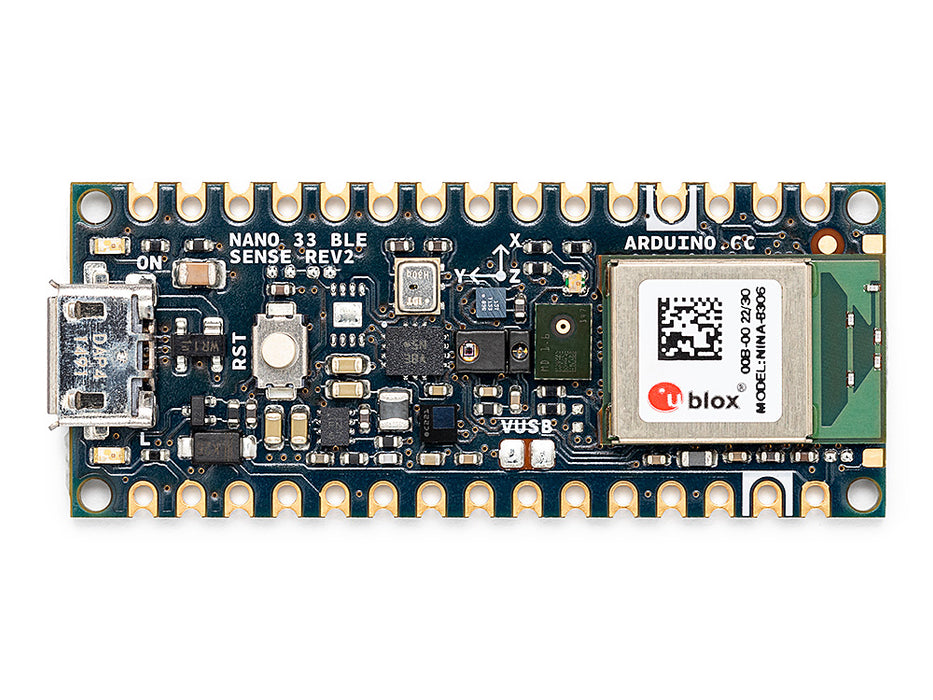
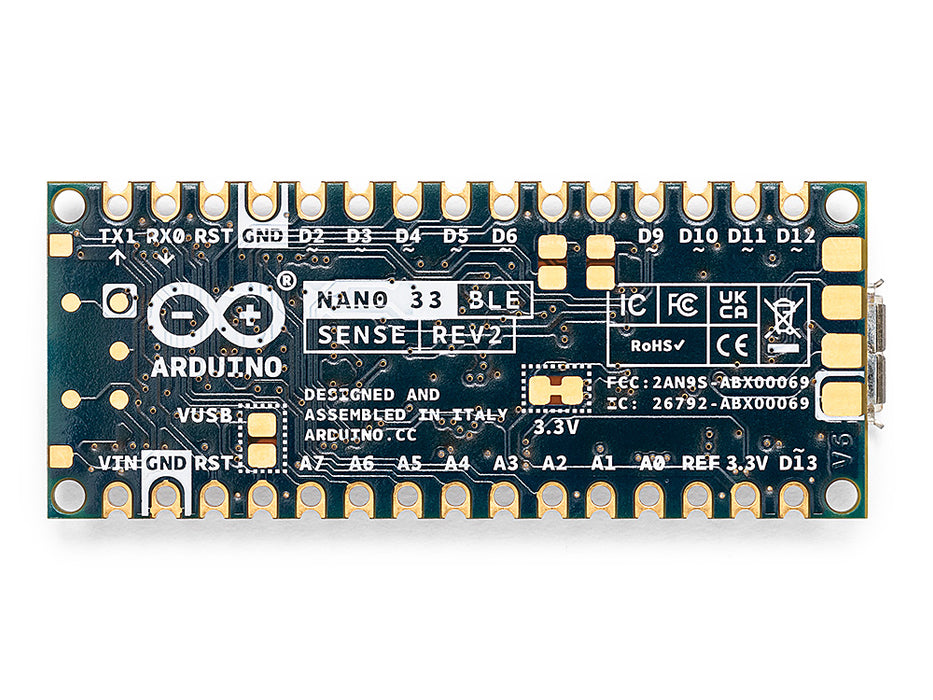
Overview
The Arduino Nano 33 BLE Sense shares its core hardware with the Arduino Nano 33 BLE — the same Nordic nRF52840 ARM Cortex-M4 microcontroller at 64 MHz, 1 MB Flash, 256 KB SRAM, and Bluetooth Low Energy 5. What sets it apart is a comprehensive collection of onboard environmental and motion sensors packed onto the same 18 × 45 mm Nano form factor.
In addition to the LSM9DS1 9-axis IMU found on the plain Nano 33 BLE, the Sense version adds a temperature and humidity sensor (HTS221), a barometric pressure sensor (LPS22HB), a PDM digital microphone (MP34DT05), and a multifunction sensor for color, proximity, and gesture detection (APDS9960). This suite of sensors makes the Nano 33 BLE Sense one of the most sensor-rich Arduino boards available at its size.
The board is closely associated with machine learning at the edge (TinyML). Arduino and Edge Impulse have collaborated to make the Nano 33 BLE Sense a first-class target for training and deploying ML models for keyword spotting, gesture recognition, and anomaly detection — all running locally on the nRF52840 without a cloud connection.
Rev2 Note
A revised version, the Arduino Nano 33 BLE Sense Rev2, is also available. It replaces the LSM9DS1 with the BMI270 + BMM150 IMU and the HTS221 with the HS3003 temperature/humidity sensor. The Rev2 also uses the BMI270 for its accelerometer/gyroscope functions and the BMM150 for the magnetometer. All other features remain the same. When purchasing, check which revision your retailer stocks.
IMPORTANT: The Nano 33 BLE Sense operates at 3.3V logic. I/O pins are NOT 5V tolerant.
Quick Overview
| Feature | Detail | |
|---|---|---|
| Microcontroller | Nordic nRF52840 (via u-blox NINA-B306) | |
| CPU | ARM Cortex-M4 with FPU | |
| Clock Speed | 64 MHz | |
| Operating/Logic Voltage | 3.3V (NOT 5V tolerant) | |
| Flash Memory | 1 MB | |
| SRAM | 256 KB | |
| Bluetooth | BLE 5.0 | |
| IMU | LSM9DS1 (9-axis) — Rev2 | BMI270 + BMM150 |
| Temperature & Humidity | HTS221 — Rev2 | HS3003 |
| Barometric Pressure | LPS22HB | |
| Microphone | MP34DT05 (PDM MEMS) | |
| Color / Proximity / Gesture | APDS9960 | |
| Dimensions | 18 × 45 mm |
Key Features
- Nordic nRF52840 ARM Cortex-M4 at 64 MHz with hardware FPU
- 1 MB Flash and 256 KB SRAM for ML model storage and inference
- Bluetooth Low Energy 5 integrated (BLE peripheral and central)
- LSM9DS1 9-axis IMU (accelerometer, gyroscope, magnetometer)
- HTS221 temperature and humidity sensor
- LPS22HB barometric pressure sensor
- MP34DT05 PDM MEMS digital microphone — suitable for keyword spotting
- APDS9960 RGB color, proximity, and gesture sensor
- Officially supported by Edge Impulse for TinyML model deployment
- Pin-compatible with the classic Arduino Nano footprint (18 × 45 mm)
- Board package: Arduino Mbed OS Nano Boards
- 3.3V logic throughout
Technical Specifications
| Parameter | Value | |
|---|---|---|
| Microcontroller | Nordic nRF52840 (via u-blox NINA-B306 module) | |
| CPU Core | ARM Cortex-M4 with FPU | |
| Clock Speed | 64 MHz | |
| Operating/Logic Voltage | 3.3V | |
| Input Voltage (USB) | 5V via micro-USB | |
| Input Voltage (VIN) | 4.5–21V | |
| USB Connector | micro-USB | |
| Flash Memory | 1 MB | |
| SRAM | 256 KB | |
| Bluetooth | BLE 5.0 | |
| Wi-Fi | Not supported | |
| IMU | LSM9DS1 (9-axis) — Rev2 | BMI270 + BMM150 |
| Temperature & Humidity | HTS221 — Rev2 | HS3003 |
| Barometric Pressure | LPS22HB | |
| Microphone | MP34DT05 (PDM digital MEMS) | |
| Color/Proximity/Gesture | APDS9960 | |
| Digital I/O Pins | 22 | |
| PWM Channels | 9 | |
| Analog Input Pins | 8 (A0–A7, 12-bit ADC) | |
| ADC Resolution | 12-bit | |
| UART | 1 | |
| I2C | 1 (external) + internal bus for sensors | |
| SPI | 1 | |
| Board Dimensions | 18 × 45 mm |
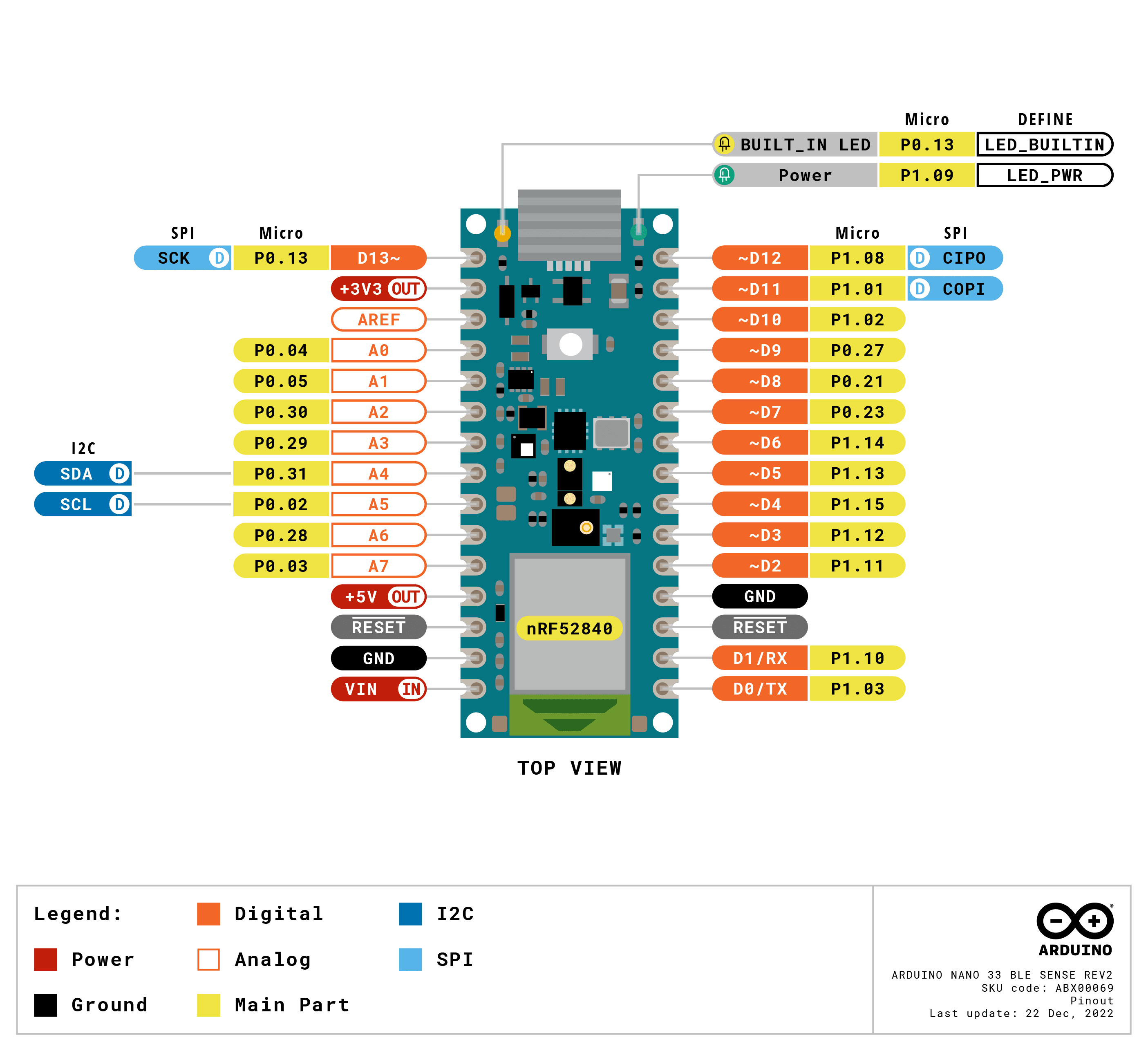
Pinout
Digital Pins
22 digital I/O pins in standard Nano layout. D0 (RX) and D1 (TX) are shared with the hardware UART. D13 is LED_BUILTIN.
PWM Pins
9 pins support PWM via analogWrite(). The nRF52840 uses configurable hardware PWM blocks.
Analog Pins
8 analog input pins (A0–A7) connected to the 12-bit SAR ADC.
Communication Pins
| Interface | Pins |
|---|---|
| UART | D0 (RX), D1 (TX) |
| I2C (external) | A4 (SDA), A5 (SCL) |
| SPI | D10 (SS), D11 (MOSI), D12 (MISO), D13 (SCK) |
Power Pins
| Pin | Function |
|---|---|
| VIN | External supply input (4.5–21V) |
| 5V | 5V output from regulator |
| 3.3V | 3.3V regulated output |
| GND | Ground |
| RESET | Resets the microcontroller |
Power
The Arduino Nano 33 BLE Sense is powered via micro-USB (5V) or the VIN pin (4.5–21V). All logic operates at 3.3V. The added sensors increase idle current slightly compared to the plain Nano 33 BLE. During BLE advertising and microphone sampling, expect 10–20 mA typical draw.
On-Board Components
| Component | Part | Function | |
|---|---|---|---|
| 9-axis IMU | LSM9DS1 (Rev2 | BMI270 + BMM150) | Accelerometer, gyroscope, magnetometer |
| Temp & Humidity | HTS221 (Rev2 | HS3003) | Relative humidity (0–100% RH) and temperature |
| Barometric Pressure | LPS22HB | Absolute pressure (260–1260 hPa) | |
| Microphone | MP34DT05 | PDM MEMS digital microphone for audio capture | |
| Color/Proximity/Gesture | APDS9960 | RGB color, ambient light, proximity, directional gesture | |
| MCU Module | u-blox NINA-B306 | Contains nRF52840 SoC and BLE antenna | |
| RGB LED | Onboard | User-addressable RGB LED |
All onboard sensors communicate with the nRF52840 over internal I2C or SPI buses. They do not occupy the external I2C or SPI pins unless the same pins are physically shared.
Wireless Connectivity
The Nano 33 BLE Sense supports Bluetooth Low Energy 5 via the nRF52840 integrated radio. Use the ArduinoBLE library for BLE peripheral and central roles. Wi-Fi is not available on this board.
Getting Started
Install the Board Package
In the Arduino IDE, open Tools > Board > Boards Manager. Search for "Arduino Mbed OS Nano Boards" and install it. Select Arduino Nano 33 BLE Sense from the board list.
Install Required Libraries
From the Library Manager, install:
- ArduinoBLE
- Arduino_LSM9DS1 (or Arduino_BMI270_BMM150 for Rev2)
- Arduino_HTS221 (or Arduino_HS300x for Rev2)
- Arduino_LPS22HB
- Arduino_APDS9960
Read All Sensors
Programming
The Nano 33 BLE Sense is programmed via the Arduino IDE using the Arduino Mbed OS Nano Boards package. If the board is not detected on USB, double-press RESET to enter bootloader mode (onboard LED will pulse slowly).
The board is also supported by TensorFlow Lite for Microcontrollers via the Harvard_TinyMLx library and the Edge Impulse Arduino library, enabling deployment of ML models trained in the cloud directly onto the device.
Package Contents
| Item | Quantity |
|---|---|
| Arduino Nano 33 BLE Sense board | 1 |
| micro-USB cable | 1 (included with some retail versions; check listing) |
Applications
- TinyML and Edge AI: keyword spotting, gesture classification, anomaly detection
- Environmental monitoring: temperature, humidity, pressure logging
- Gesture-controlled interfaces using the APDS9960
- Proximity detection and ambient light sensing
- Microphone-based audio processing and sound classification
- BLE-connected sensor nodes for IoT dashboards
- Wearable health and fitness monitors
- Research and academic machine learning projects
Where to Buy
| Retailer | Link | |
|---|---|---|
| Arduino Official Store | https | //store.arduino.cc/products/arduino-nano-33-ble-sense |
| Amazon | https | //www.amazon.com/s?k=Arduino+Nano+33+BLE+Sense |
Equivalent Boards
| Board | Key Difference |
|---|---|
| Arduino Nano 33 BLE | Same MCU and BLE, no environmental sensors (base version) |
| Arduino Nano RP2040 Connect | RP2040 MCU, Wi-Fi + BLE, onboard microphone, no full sensor suite |
| Arduino Nano 33 IoT | SAMD21 MCU, Wi-Fi + BLE 4.2, no onboard sensors |
Documentation
| Resource | Link | |
|---|---|---|
| Official Product Page | https | //store.arduino.cc/products/arduino-nano-33-ble-sense |
| Documentation & Pinout | https | //docs.arduino.cc/hardware/nano-33-ble-sense |
| Edge Impulse Integration | https | //docs.edgeimpulse.com/docs/development-platforms/officially-supported-mcu-targets/arduino-nano-33-ble-sense |
| ArduinoBLE Library | https | //www.arduino.cc/reference/en/libraries/arduinoble/ |
| nRF52840 Product Spec | https | //infocenter.nordicsemi.com/pdf/nRF52840_PS_v1.7.pdf |
Notes
- WARNING: The Nano 33 BLE Sense operates at 3.3V logic. I/O pins are NOT 5V tolerant. Applying 5V signals can permanently damage the board. Use a level shifter for 5V peripherals.
- Rev1 uses LSM9DS1 + HTS221. Rev2 uses BMI270 + BMM150 + HS3003. These require different Arduino libraries — check your board revision before installing libraries.
- The MP34DT05 microphone outputs PDM (Pulse Density Modulation) audio. Use the PDM library included with the Mbed OS board package to capture audio samples.
- The APDS9960 gesture detection works best when the sensor is unobstructed and at close range (a few centimeters). Enclosure design should account for the sensor's field of view.
- The onboard sensors share internal I2C buses with the MCU. They do not interfere with devices connected to the external A4/A5 I2C pins.
- The Nano 33 BLE Sense does not include Wi-Fi. For Wi-Fi + sensors, an external Wi-Fi module or a different board is required.
Community
- Arduino Forum — official community for questions and projects
- Arduino Discord — real-time chat with the Arduino community
- r/arduino (Reddit) — share projects and ask questions
- Arduino Project Hub — browse community-submitted projects
Revision History
| Version | Date | Notes |
|---|---|---|
| v1.0 | 2026-06 | Initial entry |