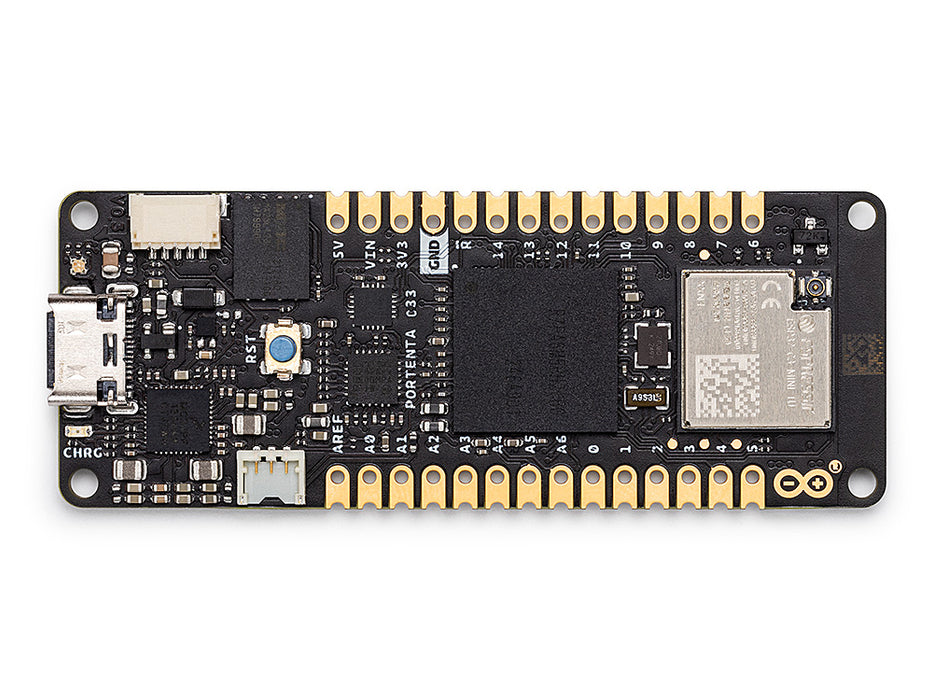
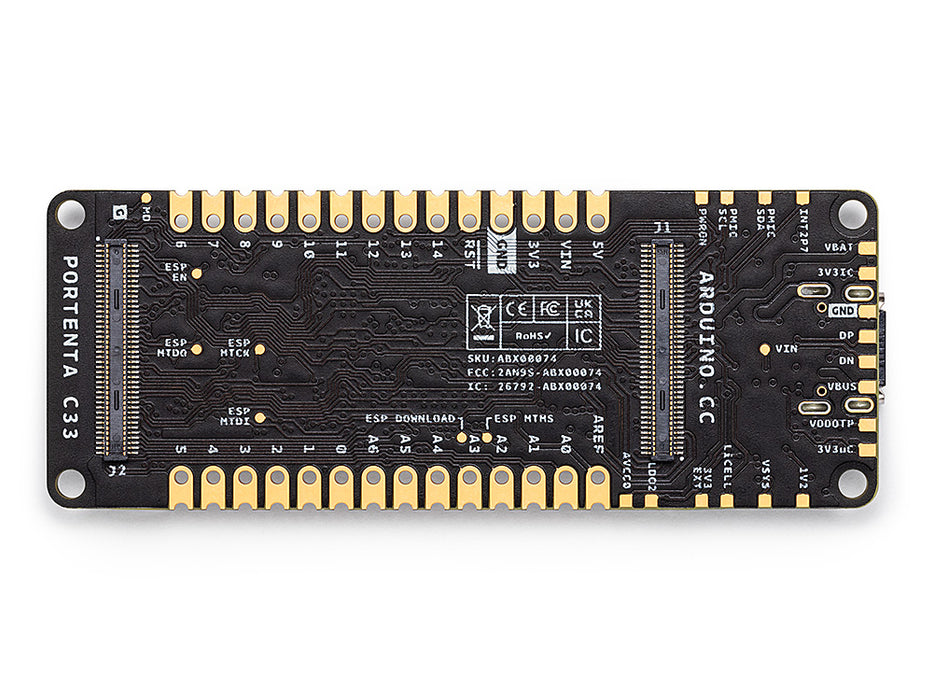
The Arduino Portenta C33 is a professional-grade microcontroller board designed as a more affordable alternative to the Arduino Portenta H7. It shares the same physical form factor — including the two 80-pin high-density connectors — making it compatible with the full ecosystem of Portenta carrier boards, shields, and Vision Shields.
Rather than the STM32H747 used in the H7, the Portenta C33 is powered by the Renesas R7FA6M5BH2CBG, an ARM Cortex-M33 running at 200 MHz. Wireless connectivity is handled by an ESP32-C3 module, providing Wi-Fi 802.11 b/g/n and Bluetooth 5.0 LE. The board is suitable for industrial IoT, edge computing, and production deployments where the full dual-core power of the H7 is not required but the same carrier board ecosystem is desired.
| Property | Value |
|---|
| MCU | Renesas R7FA6M5BH2CBG (Cortex-M33 @ 200 MHz) |
| SRAM | 512 KB internal |
| Flash | 2 MB internal + 16 MB external QSPI |
| Wireless | Wi-Fi 802.11 b/g/n + Bluetooth 5.0 LE (ESP32-C3) |
| USB | USB-C |
| I/O Connectors | 2 × 80-pin high-density connectors |
| Operating Voltage | 3.3V |
| RTC | Built-in |
| ADC | Multiple 12-bit channels |
| SKU | ABX00074 |
Renesas R7FA6M5BH2CBG Cortex-M33 at 200 MHz — efficient and capable single-core processor
512 KB internal SRAM and 2 MB internal Flash for application storage
16 MB external QSPI Flash for data and larger firmware storage
ESP32-C3 module providing Wi-Fi 802.11 b/g/n (2.4 GHz) and Bluetooth 5.0 LE
Two 80-pin high-density connectors — fully compatible with Portenta H7 carrier boards
Built-in RTC (Real-Time Clock) with external crystal support
Multiple 12-bit ADC channels for analog sensing
USB-C connectivity for programming and power
More affordable than the Portenta H7 while maintaining the same form factor and carrier compatibility
Suitable for production deployments where cost optimization matters
Supports Arduino Mbed OS framework and Arduino IDE
| Parameter | Value |
|---|
| Microcontroller | Renesas R7FA6M5BH2CBG |
| Core Architecture | ARM Cortex-M33 |
| Clock Speed | 200 MHz |
| Internal SRAM | 512 KB |
| Internal Flash | 2 MB |
| External QSPI Flash | 16 MB |
| Wireless Module | ESP32-C3 |
| Wi-Fi Standard | 802.11 b/g/n (2.4 GHz) |
| Bluetooth | 5.0 LE |
| USB | USB-C |
| I/O Connectors | 2 × 80-pin high-density (bottom) |
| Operating Voltage | 3.3V |
| ADC Resolution | 12-bit (multiple channels) |
| RTC | Built-in with external crystal support |
| Camera Connector | Available (via high-density connector) |
| Display Connector | Available (via carrier board) |
| Dimensions | 66.04 × 25.4 mm |
Like the Portenta H7, the Portenta C33 exposes I/O via two 80-pin high-density board-to-board connectors (J1 and J2) on the underside. Individual pin access requires a Portenta Breakout board or a compatible carrier board.
| Signal Group | Description |
|---|
| Digital I/O | Multiple GPIO at 3.3V logic |
| Analog Inputs | 12-bit ADC channels |
| PWM | Multiple PWM-capable pins |
| UART | Multiple UART interfaces |
| SPI | SPI bus |
| I2C | I2C bus |
| CAN | CAN bus interface |
| USB | USB differential pair (via USB-C) |
| Camera | Camera interface (via carrier board routing) |
| Display | Display interface (via carrier board routing) |
| Ethernet | 10/100 Mbps (via carrier board) |
| Power Parameter | Value |
|---|
| Input Voltage (USB) | 5V via USB-C |
| Input Voltage (External) | 5V via high-density connector VIN pin |
| Operating Voltage (I/O) | 3.3V |
| Battery Support | Via carrier board |
| Power Consumption | Lower than Portenta H7 due to single-core Cortex-M33 |
The Portenta C33 is a 3.3V board. Do not apply 5V signals to I/O pins without verifying tolerance in the Renesas R7FA6M5 datasheet.
| Component | Part | Function |
|---|
| Microcontroller | Renesas R7FA6M5BH2CBG | Cortex-M33 main processor |
| Wireless Module | ESP32-C3 | Wi-Fi 802.11 b/g/n + Bluetooth 5.0 LE |
| External Flash | 16 MB QSPI | Extended program and data storage |
| USB-C Connector | On-board | Programming, power, and data |
| High-Density Connectors | 2 × 80-pin | Carrier board interface (J1 and J2) |
| RTC Crystal | On-board | Real-time clock support |
| Power LED | On-board | Power indicator |
| User LED | On-board (RGB) | Programmable status indicator |
The Renesas R7FA6M5BH2CBG belongs to the RA6M5 group of Renesas RA microcontrollers, based on the ARM Cortex-M33 architecture.
| Feature | Value |
|---|
| Core | ARM Cortex-M33 |
| Clock Speed | 200 MHz |
| FPU | Yes (single-precision) |
| DSP | Yes (DSP extension instructions) |
| Security | TrustZone support |
| Internal SRAM | 512 KB |
| Internal Flash | 2 MB |
| ADC | 12-bit, multiple channels |
| UART | Multiple interfaces |
| I2C | Multiple interfaces |
| SPI | Multiple interfaces |
| CAN | CAN bus support |
| RTC | Built-in |
The Cortex-M33 includes TrustZone security extensions, which can be used for secure key storage and trusted execution environments in security-sensitive applications.
The ESP32-C3 module handles all wireless communication on the Portenta C33. It operates as a co-processor dedicated to Wi-Fi and Bluetooth, offloading wireless tasks from the main Renesas MCU.
| Wireless Feature | Value |
|---|
| Module | ESP32-C3 |
| Wi-Fi | 802.11 b/g/n (2.4 GHz) |
| Bluetooth | 5.0 LE |
| Protocol | TCP/IP, MQTT, HTTP, HTTPS, TLS |
| Arduino Library | WiFi (via Arduino Portenta C33 core) |
Arduino IDE 2.x (recommended)
Install the Arduino Renesas Portenta Boards package via Boards Manager
USB-C cable (data-capable)
Optional: Portenta Breakout board for pin access
Open Arduino IDE
Go to Tools > Board > Boards Manager
Search for "Arduino Renesas Portenta Boards" and install
Select Tools > Board > Arduino Portenta C33
Connect the board via USB-C
Select the correct port under Tools > Port
void setup() {
pinMode(LEDB, OUTPUT);
Serial.begin(115200);
while (!Serial);
Serial.println("Portenta C33 ready");
}
void loop() {
digitalWrite(LEDB, LOW);
delay(500);
digitalWrite(LEDB, HIGH);
delay(500);
}
#include <WiFi.h>
const char* ssid = "YOUR_SSID";
const char* password = "YOUR_PASSWORD";
void setup() {
Serial.begin(115200);
while (!Serial);
Serial.print("Connecting to ");
Serial.println(ssid);
WiFi.begin(ssid, password);
while (WiFi.status() != WL_CONNECTED) {
delay(500);
Serial.print(".");
}
Serial.println();
Serial.println("Connected to Wi-Fi");
Serial.print("IP address: ");
Serial.println(WiFi.localIP());
}
void loop() {
}
| Environment | Details |
|---|
| Arduino IDE | Full support via Arduino Renesas Portenta Boards package |
| Arduino framework | Standard setup()/loop() structure supported |
| MicroPython | Community support available |
| Item | Quantity |
|---|
| Arduino Portenta C33 board | 1 |
A USB-C cable and carrier board are sold separately.
Industrial IoT (IIoT) edge nodes
Cost-optimized production deployments on Portenta carrier boards
Smart building and energy monitoring
Fleet management and asset tracking
Wireless sensor nodes with BLE or Wi-Fi
Predictive maintenance data loggers
Gateway devices for MQTT/cloud connectivity
Automation controllers using Portenta carrier boards
Amazon — search for Arduino Portenta C33
| Board | MCU | Key Difference |
|---|
| Arduino Portenta H7 | STM32H747XI (dual-core M7+M4, 480 MHz) | More powerful, dual-core, more expensive |
| Arduino Portenta X8 | NXP i.MX 8M Mini (A53 Linux) + STM32H747 | Linux-capable, highest tier |
All I/O on the Portenta C33 operates at 3.3V logic. Do not connect 5V signals to I/O pins without verifying tolerance in the Renesas datasheet.
The Portenta C33 is pin-for-pin compatible with the Portenta H7 via the high-density connectors, but some advanced peripherals (e.g., MIPI DSI video output) are not present on the C33.
The ESP32-C3 handles Wi-Fi and Bluetooth as a co-processor. It communicates with the Renesas MCU internally; users interact with it through standard Arduino WiFi library calls.
A Portenta Breakout board is required to access individual I/O pins for prototyping.
| Version | Date | Notes |
|---|
| v1.0 | 2026-06 | Initial entry |