
Raspberry Pi Pico 2
Image Gallery
Overview
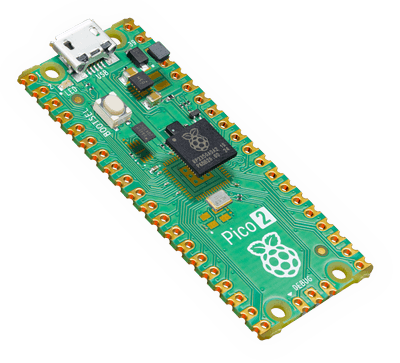
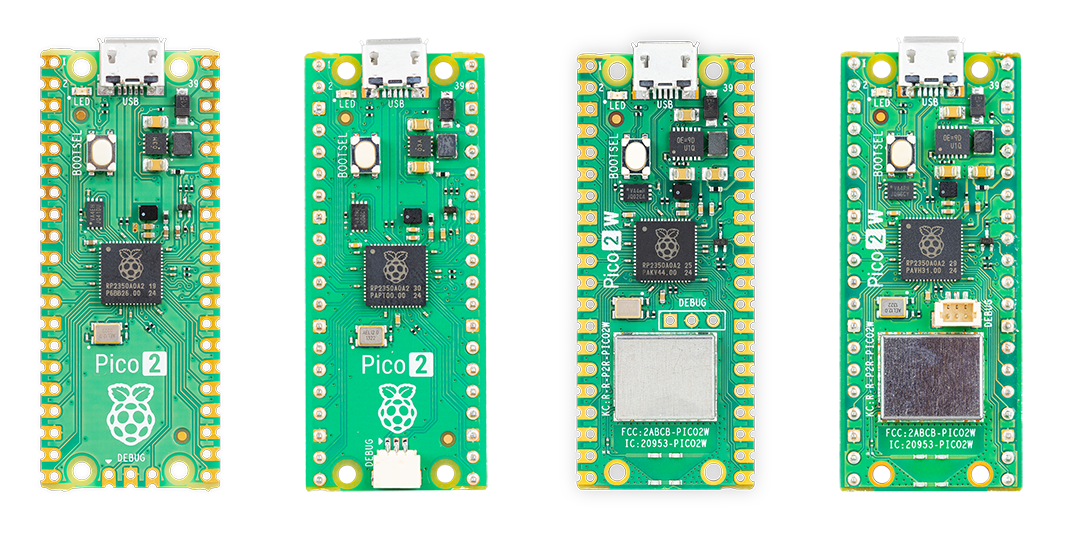
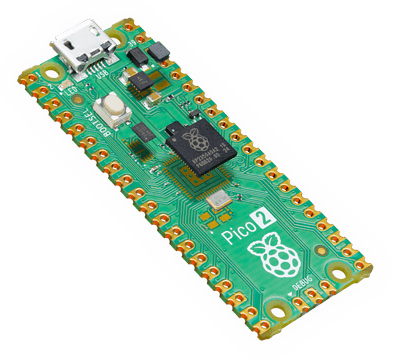
The Raspberry Pi Pico 2 is the second-generation Raspberry Pi microcontroller board, released in August 2024. It is powered by the RP2350, Raspberry Pi's own second-generation microcontroller chip, which introduces a significant architecture upgrade over the RP2040 found in the original Pico. The RP2350 features dual ARM Cortex-M33 cores (or dual RISC-V Hazard3 cores — user-selectable at boot) running at up to 150 MHz, 520 KB of on-chip SRAM, and expanded PIO capability with three PIO blocks totalling 12 state machines.
Hardware security features including ARM TrustZone (on Cortex-M33) and a True Random Number Generator (TRNG) make the Pico 2 suitable for security-conscious embedded designs. The board maintains full pin-compatibility with the original Pico footprint, allowing direct substitution in most existing designs. Unpopulated headers keep the profile slim for production builds.
Key Features
- RP2350 SoC: dual-core ARM Cortex-M33 OR dual-core RISC-V Hazard3 (user-selectable)
- Up to 150 MHz clock speed
- 520 KB on-chip SRAM
- 4 MB QSPI flash (W25Q32)
- 3 × PIO blocks with 4 state machines each (12 PIO state machines total)
- ARM TrustZone security (Cortex-M33 mode) + True RNG
- 26 user-accessible GPIO pins (30 total)
- 3 × 12-bit ADC inputs + 1 internal temperature sensor
- Up to 24 PWM channels
- USB 1.1 device and host mode
- Backward-compatible footprint with original Raspberry Pi Pico
- Supports MicroPython, C/C++ SDK, CircuitPython
- No Wi-Fi or Bluetooth (see Pico 2 W for wireless)
- Unpopulated 40-pin header (solder pins yourself)
- Dimensions: 51 × 21 mm
Technical Specifications
| Specification | Details |
|---|---|
| MCU | Raspberry Pi RP2350 |
| Cores | Dual ARM Cortex-M33 or dual RISC-V Hazard3 @ up to 150 MHz |
| SRAM | 520 KB on-chip |
| Flash | 4 MB QSPI |
| GPIO (user) | 26 (pins 0–22, 26–28) |
| GPIO (total) | 30 |
| ADC | 3× 12-bit GPIO + 1 internal temperature sensor |
| PWM | Up to 24 channels |
| PIO | 3 blocks × 4 state machines = 12 total |
| I2C | 2 |
| SPI | 2 |
| UART | 2 |
| USB | USB 1.1 device and host |
| Operating Voltage | 1.8–5.5V (VSYS), 3.3V I/O |
| Power Input | Micro USB or VSYS pin |
| Wi-Fi | None |
| Bluetooth | None |
| Header | 40-pin (unpopulated) |
| Dimensions | 51 × 21 mm |
| OS / Runtime | MicroPython, CircuitPython, C/C++ SDK |
Pinout
The Raspberry Pi Pico 2 uses the same 40-pin footprint as the original Pico, with two rows of 20 pins along the long edges and four castellated holes at the corners.
| Pin(s) | Function |
|---|---|
| 1–2 | GP0, GP1 (UART0 TX/RX, SPI0 RX/CSn, I2C0 SDA/SCL) |
| 4–5 | GP2, GP3 (SPI0 SCK/TX, I2C1 SDA/SCL) |
| 6–7 | GP4, GP5 (UART1 TX/RX, I2C0 SDA/SCL) |
| 31–32 | GP26, GP27 (ADC0, ADC1) |
| 34 | GP28 (ADC2) |
| 36 | 3V3 Out |
| 37 | 3V3_EN (pull LOW to disable 3.3V regulator) |
| 38 | GND |
| 39 | VSYS (2.3–5.5V input) |
| 40 | VBUS (USB 5V) |
Power
The Pico 2 can be powered via micro USB (VBUS, 5V) or directly through the VSYS pin (1.8–5.5V). An on-board switching regulator steps down to 3.3V for the RP2350 and GPIO. The 3V3_EN pin allows external hardware to power-cycle the board.
Microcontroller
The Raspberry Pi Pico 2 is built around the RP2350, Raspberry Pi's second-generation in-house microcontroller.
Dual ISA — ARM and RISC-V
The RP2350's most distinctive feature is its dual-architecture design. The chip contains two ARM Cortex-M33 cores and two RISC-V Hazard3 cores. At boot, firmware selects which ISA to use — ARM Cortex-M33 (the default and most supported) or RISC-V Hazard3 (an open-source core also designed by Raspberry Pi). Only one ISA pair is active at a time.
Programmable I/O (PIO)
The RP2350 includes three independent PIO blocks, each with four state machines — 12 PIO state machines in total (compared to eight in the RP2040). PIO state machines execute compact, deterministic programs from a small instruction memory and can implement custom hardware interfaces (SPI, I2S, WS2812 NeoPixel, stepper motor step/dir, custom serial protocols) without CPU involvement, achieving precise timing that would be impossible in software.
Security
The Cortex-M33 cores include ARM TrustZone, enabling secure and non-secure execution zones. A hardware True Random Number Generator (TRNG) is included on-chip. OTP (One-Time Programmable) storage can lock boot configurations.
| Feature | RP2350 Details |
|---|---|
| Cores | 2× ARM Cortex-M33 or 2× RISC-V Hazard3 (selectable) |
| Clock Speed | Up to 150 MHz |
| SRAM | 520 KB (on-chip) |
| Flash | 4 MB external QSPI (Pico 2 includes W25Q32) |
| PIO Blocks | 3 (4 state machines each = 12 total) |
| ADC | 4 channels (3 user GPIO + 1 internal temp) |
| PWM Channels | Up to 24 |
| USB | USB 1.1 (device + host) |
| Security | ARM TrustZone, TRNG, OTP |
Getting Started
What You Need
- Raspberry Pi Pico 2
- Micro USB cable
- Computer with Thonny IDE or VS Code + Pico SDK
- Optional: 40-pin header + breadboard
Flashing MicroPython
- Download the latest MicroPython UF2 for Pico 2 from https://micropython.org/download/RPI_PICO2/
- Hold the BOOTSEL button on the Pico 2 and connect it to your computer via USB.
- Release BOOTSEL — the board mounts as a USB drive named RPI-RP2.
- Drag and drop the UF2 file onto the drive. The board reboots into MicroPython.
- Open Thonny IDE, select the Pico as the interpreter, and start coding.
Programming
MicroPython LED Blink
The Raspberry Pi Pico 2 has an on-board LED connected to GPIO 25.
C/C++ SDK
Install the Raspberry Pi Pico C/C++ SDK, set up the toolchain, and use CMake-based projects. The SDK supports both ARM and RISC-V targets for the RP2350.
CircuitPython
Download the CircuitPython UF2 for Pico 2 from https://circuitpython.org/board/raspberry_pi_pico2/ and drag it onto the board in BOOTSEL mode.
Applications
- Embedded control systems requiring hardware security
- Custom hardware interface prototyping with PIO
- Motor and servo controllers
- Audio synthesis and digital signal processing
- High-speed data acquisition
- Robotics platforms
- USB HID devices (keyboard/mouse emulation)
- RISC-V learning and experimentation
Where to Buy
- Official page: https://www.raspberrypi.com/products/raspberry-pi-pico-2/
- Amazon: https://www.amazon.com/s?k=Raspberry+Pi+Pico+2
- Approved resellers: https://www.raspberrypi.com/products/raspberry-pi-pico-2/
Equivalent Boards
| Board | Key Difference |
|---|---|
| Raspberry Pi Pico | RP2040 predecessor — single ISA, 264 KB SRAM, 8 PIO SMs, no TrustZone |
| Raspberry Pi Pico 2 W | Pico 2 with added Wi-Fi and Bluetooth |
| Arduino Nano RP2040 Connect | RP2040 (not RP2350) + Arduino ecosystem + Wi-Fi + IMU |
| STM32 Nucleo series | ARM Cortex-M33 alternative, ST ecosystem, wider peripheral range |
Documentation
- Official page: https://www.raspberrypi.com/products/raspberry-pi-pico-2/
- Microcontroller documentation: https://www.raspberrypi.com/documentation/microcontrollers/
- RP2350 datasheet: https://datasheets.raspberrypi.com/rp2350/rp2350-datasheet.pdf
- MicroPython for Pico 2: https://micropython.org/download/RPI_PICO2/
Community
- Raspberry Pi Forums — official community
- r/raspberry_pi (Reddit) — share projects
- Raspberry Pi Discord — real-time chat
Revision History
| Version | Date | Notes |
|---|---|---|
| v1.0 | 2026-06 | Initial entry |